
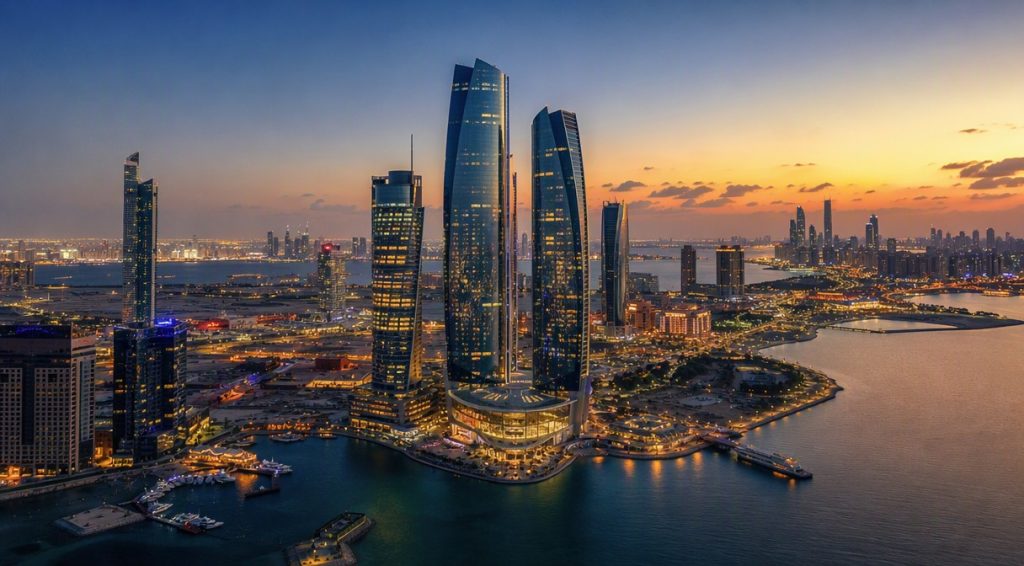
Written by the Bramwell & Partners advisory team — Abu Dhabi real estate advisors. Last reviewed: October 2026.
There is no single "best" off-plan area in the UAE — there is only the best area for a stated goal. A yield investor comparing one-bedroom apartments, a family looking for a four-bedroom townhouse, and an overseas buyer seeking a scarce long-hold asset are shopping in three different markets that happen to share a currency. This guide, written by an Abu Dhabi advisory that also places clients across Dubai and the wider Emirates, maps each leading area to the buyer it actually suits — with the numbers on yields, service charges and entry prices that most area rankings leave out.
We visit every community in this guide on a regular cycle — the evening exit queues at JVC, the Friday crowds on Al Marjan’s beaches, the construction pace along Dubai South’s boulevards, the school-run build-up on Yas — because how a place feels at rush hour predicts tenant demand and resale depth better than any launch render. The comparisons below come from that fieldwork as much as from the data.
Key takeaways
- Decide income versus lifestyle before comparing areas: Dubai apartments gross around 6.5–7% on average against roughly 4.9–5.2% for villas, and Abu Dhabi’s districts span about 5.5–9.8% gross for apartments (ADREC 2025 district data).
- Abu Dhabi deserves a harder look than most Dubai-centric rankings give it: Yas, Saadiyat, Al Reem and Al Raha offer registered price transparency through ADREC and end-user stability.
- Service charges decide net yield: roughly AED 8–14 per sq ft in JVC versus AED 15–25-plus in prime Dubai towers — a one to two point swing on net returns.
- Off-plan accounted for about 72.9% of Dubai residential transaction value in 2025 (Cavendish Maxwell) and 71% of Abu Dhabi’s residential sales value (ADREC) — off-plan is the main market, not a niche.
- Match your budget and goal first; choose the developer second, the project third, and the payment plan last.
The table below is the routing layer for the whole guide. Yield and service-charge figures are indicative market ranges compiled from public data (Bayut/DLD market reports for Dubai; ADREC-based district data for Abu Dhabi) as of late 2026 — treat them as orientation and verify building-level figures before committing.
| Area | Emirate | Entry (typical) | Indicative gross yield | Service charge (AED/sq ft/yr) | Best for |
|---|---|---|---|---|---|
| JVC | Dubai | AED 0.45–1.1m (apt) | ~6.5–8% | ~8–14 | Yield-led investors |
| Business Bay | Dubai | AED 1.2m+ | ~5.5–6.5% | ~15–25 | Central location, liquidity |
| Dubai Creek Harbour | Dubai | AED 1.5m+ | ~5.5–7% | ~15–22 | Waterfront growth, Blue Line |
| Dubai Hills Estate | Dubai | AED 1.45m+ | ~5–6% | ~13–18 | Families, end-users |
| Dubai South | Dubai | AED 1.1m+ | ~6–8% | ~9–14 | Patient growth buyers |
| Yas Island | Abu Dhabi | AED 1.2m+ | ~5–6% (higher on short-lets) | ~12–18 | Lifestyle + income balance |
| Saadiyat Island | Abu Dhabi | AED 2m+ | ~4.5–5.5% | ~15–30+ (branded) | Long-hold luxury, scarcity |
| Al Reem Island | Abu Dhabi | AED 0.6m+ | ~6–8% | ~12–16 | Urban yield, professionals |
| Al Marjan Island | Ras Al Khaimah | AED 0.8m+ | ~6–8% (tourism-led) | ~10–16 | Lifestyle, short-stay thesis |
| Aljada / Masaar | Sharjah | AED 0.7m+ | ~6–7% | ~8–12 | Lower entry, cross-emirate families |
First-time and yield-led investors. Start with Dubai’s mid-market apartment communities. JVC remains the benchmark — Bayut’s H1 2026 analysis of DLD data put its gross yield at roughly 7.15%, with studios averaging about AED 690,000 and one-bedrooms near AED 1.15 million — followed by Arjan, Al Furjan and Dubai Silicon Oasis, with Dubai South as the growth-thesis alternative. In Abu Dhabi, Al Reem Island and Al Raha Beach play the same role with ADREC-registered rent evidence. The disciplines are identical: check concurrent handover supply, insist on the building’s actual service charge (published on Dubai’s Mollak system or confirmed in writing in Abu Dhabi), and model net, not gross.
Family end-users. Dubai Hills Estate (schools, a 180,000 sq m park, King’s College Hospital inside the community), The Valley, and Town Square lead Dubai’s list; in Abu Dhabi, Yas Island’s canal-side and park districts and Saadiyat’s villa communities serve families who prioritise schools, beaches and lower density. For families, the commute and school route at real hours matter more than any yield figure.
Capital-growth and long-hold buyers. Dubai Creek Harbour (Emaar waterfront with the Metro Blue Line scheduled to open in September 2029), Dubai South (the Al Maktoum International Airport expansion corridor) and Abu Dhabi’s Yas Point and Marsa Al Saadiyat districts represent the infrastructure-led theses. These reward patience and punish buyers who need a quick exit.
Premium and lifestyle buyers. Saadiyat Island is Abu Dhabi’s cultural-and-beach luxury district; Dubai’s equivalents are Downtown, Dubai Marina’s branded towers and the villa estates at The Oasis and Nad Al Sheba. At AED 5 million and above, buy the home and location first and the brand second.
Short-stay and tourism-led buyers. Yas Island (events calendar, holiday-home licensing where permitted) and Al Marjan Island in Ras Al Khaimah (Wynn resort-led tourism thesis) are the two clearest plays. Both require you to verify holiday-home eligibility and realistic management costs before underwriting income.
Bramwell & Partners — Investor Proof
We help investors make money investing in Abu Dhabi properties — and we can prove it.
Download our Proof of Concept: three executed off-plan flips, real contracts, ≈62% blended ROI in 12 months with only 20% capital deployed.
Most "best areas" guides are written from Dubai and treat the capital as an afterthought. The reality is more balanced:
A final word on sequencing, because it is where most overseas buyers lose money: choose the area before the project, and the project before the payment plan. Buyers who fall in love with a launch event and retrofit an area rationale around it routinely end up in the wrong community for their goal. Work the other way — profile, budget, area, developer, building, unit — and most weak options eliminate themselves before you ever pay a reservation amount.
An illustrative brief we see regularly: an overseas investor with AED 1.5 million, torn between a Dubai mid-market one-bedroom and an Abu Dhabi two-bedroom at the same total outlay. The answer depended on financing, target tenant and exit horizon — not on which area ranked higher on a list. That is the point of this guide: the area follows the brief, never the reverse.
Expert view from Bramwell & Partners
"We are an Abu Dhabi advisory, so you might expect us to say the capital is always the answer. It is not. For a pure yield investor with AED 700,000, Dubai’s mid-market is usually the right first purchase. Where Abu Dhabi wins — and where our clients consistently do well — is in the AED 1.2–5 million band: Yas and Al Raha for balanced income and lifestyle, Saadiyat for long-hold scarcity. The emirate’s 2% transfer fee, lower service charges and ADREC transparency compound quietly in your favour over a five-to-ten-year hold."
Among established communities, Dubai’s JVC leads mainstream yield tables at roughly 6.5–8% gross, with International City, Dubai Sports City and Dubai Silicon Oasis competitive at lower entry prices. In Abu Dhabi, ADREC 2025 district data shows apartment gross yields of about 5.5–9.8%, with Al Reef, Al Ghadeer and Al Reem at the upper end. Always net out service charges before comparing.
Dubai offers deeper liquidity, more project choice and higher headline apartment yields. Abu Dhabi offers lower entry friction (2% ready transfer fee), competitive service charges, end-user stability and registered price transparency via ADREC. Yield-led buyers often start in Dubai; AED 1.2–5 million buyers balancing income and lifestyle frequently do better in Abu Dhabi.
Studios in Dubai’s value communities start around AED 450,000–650,000; Abu Dhabi’s Al Reem Island from similar levels. Family townhouses cluster around AED 2–3.5 million (The Valley, Dubai South, Yas Island). Prime and luxury product begins near AED 2 million on Saadiyat and AED 5 million-plus in Dubai’s branded tier.
Yes — property purchases of AED 2 million or more can support a Golden Visa application, and qualifying off-plan purchases from approved developers count before completion, subject to current rules. Confirm eligibility against the latest federal guidance before relying on it.
For the right buyer. Al Marjan Island (Ras Al Khaimah) is a tourism-led lifestyle play tied to resort delivery, and Aljada and Masaar (Sharjah) offer lower entry prices for cross-emirate families. Both have thinner resale liquidity and ownership frameworks that differ from Dubai and Abu Dhabi — verify emirate-specific rules first.
Ignore the booking amount and map the full schedule: what is due during construction, at handover, and post-handover. A 10/30/60 plan and a 20/30/50 plan on the same AED 2 million home differ by AED 200,000 in both upfront cash and completion balance. Then stress-test the schedule against a delay.
How we verify this guide. Yield and service-charge ranges are compiled from Bayut/DLD H1 2026 market reports, ADREC 2025 district data and DLD Mollak service-charge records, checked October 2026. They are indicative ranges for orientation — verify building-level figures before committing to any area or project.
Disclosure: Bramwell & Partners may act for buyers in some projects mentioned; our analysis is independent of developers.
Area research narrows the field; the final decision is always unit-level. Bramwell & Partners advises buyers across Abu Dhabi and the wider UAE from our Abu Dhabi base — comparing live releases, service-charge schedules and registered comparable evidence against your budget and goal.
Browse current off-plan projects across the UAE · Explore sales and rental listings · Enquire with Bramwell & Partners for a tailored area shortlist.
Institutional-Grade Investment Guidance
Talk directly to our advisory team
WhatsApp us at +971 56 494 7631 — we reply personally, usually within the hour.