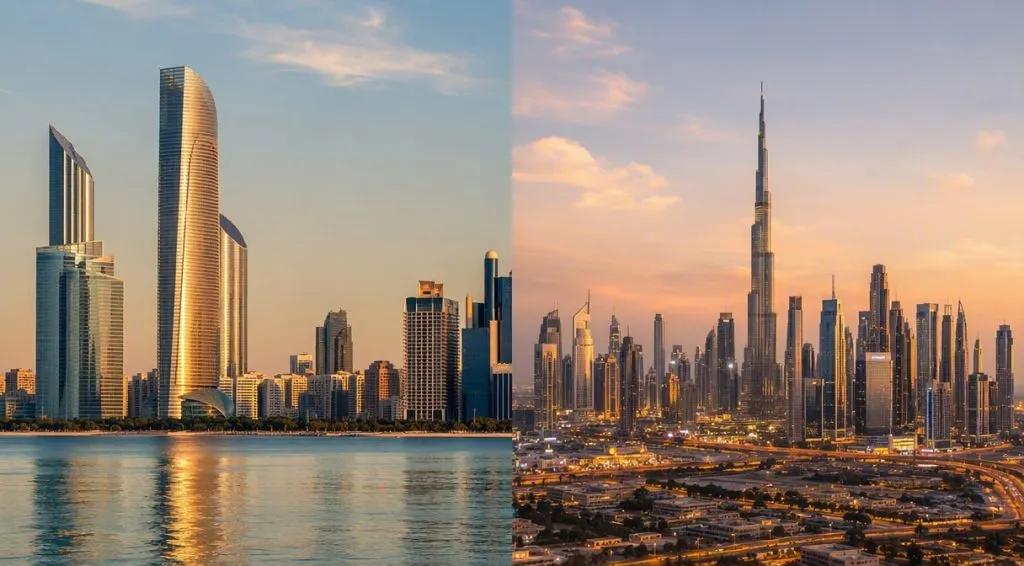
Written by the Bramwell & Partners advisory team, Abu Dhabi real estate advisors. Last reviewed: October 2026.
Every week, buyers ask us some version of the same question: should I buy off-plan in Dubai, or in Abu Dhabi? The honest answer is that both markets are well regulated, both have credible developers, and both can produce strong returns, but they reward different strategies. Dubai is a high-liquidity, high-choice trading market. Abu Dhabi is a lower-density, end-user-led market where the best island communities have been compounding value faster than almost anywhere else in the UAE.
This guide compares the two emirates on the things that actually decide your result: what it costs to get in, what you earn while you hold, how easily you can exit, and who each market suits. We work in Abu Dhabi every day, so we will be candid about where Dubai genuinely wins, and where the capital quietly has the better of it.
Key takeaways
- Dubai's off-plan market is roughly eight times larger by transaction count; Abu Dhabi's is smaller but grew faster in 2025–2026, led by Yas, Saadiyat, Reem and Hudayriyat islands.
- Buyer-side registration is typically 4% in Dubai and around 1% in Abu Dhabi, a AED 60,000 difference on a AED 2m purchase before you have furnished anything.
- Gross yields are close (Dubai ~6.6%, Abu Dhabi ~6.1% market-wide, March 2026), but Abu Dhabi's entry prices per square foot are lower and recent capital growth has been sharper.
- Dubai suits investors who need deep resale liquidity and short-let depth; Abu Dhabi suits end-users, long-hold investors and buyers priced by the square foot rather than the brochure.
- For overseas buyers from India, the UK and the US, the decision often comes down to ticket size, currency planning and whether the purchase is lifestyle-led or purely financial.
How the two off-plan markets actually differ
Dubai's defining feature is scale. Dubai Land Department records for H1 2026 show roughly 79,700 residential sales worth AED 227bn, with off-plan accounting for about 71% of transactions. More than 220 projects recorded their first off-plan sale in six months. Whatever your budget between AED 650,000 and AED 25m, there are dozens of viable projects competing for you.
Abu Dhabi's market is smaller and more concentrated. CBRE's Q1 2026 analysis recorded around 8,300 deals worth AED 46bn, with off-plan making up roughly 81% of activity, concentrated on four islands: Yas, Saadiyat, Al Reem and Hudayriyat. The practical consequence: in Dubai you compare ten similar projects; in Abu Dhabi you compare three or four genuinely differentiated ones.
That concentration cuts both ways. Dubai's depth gives you liquidity and choice, but also competing supply, thousands of near-identical units completing in the same quarter in the same district. Abu Dhabi's leading communities are scarcer, which is one reason CBRE recorded residential prices up around 32% year on year in Q1 2026 and rents up about 15%.
Head-to-head: the numbers that matter
| Measure | Dubai | Abu Dhabi |
|---|---|---|
| Residential transactions (latest half/quarter) | ~79,700 sales, AED 227bn (H1 2026, DLD) | ~8,300 deals, AED 46bn (Q1 2026, CBRE) |
| Off-plan share of activity | ~71% | ~81% |
| Buyer-side registration fee (typical primary sale) | 4% DLD fee usually allocated to buyer | 2% ADREC fee, typically split, ~1% to buyer |
| Average apartment price (Q1 2026) | ~AED 1,871 / sq ft | ~AED 1,665 / sq ft |
| Average villa price (Q1 2026) | ~AED 2,376 / sq ft | ~AED 1,189 / sq ft |
| Gross residential yield (March 2026, FAB/REIDIN) | 6.6% (7.1% apartments) | 6.1% (6.6% apartments) |
| Foreign ownership | Designated freehold areas | Designated investment areas (Yas, Saadiyat, Reem, Hudayriyat etc.) |
| Contract registration | Oqood (DLD) | ADREC off-plan SPA registration |
| Market character | Deep, international, tradeable | End-user-led, island-focused, lower density |
Sources: Dubai Land Department transaction records, CBRE UAE Real Estate Market Review Q1 2026, FAB Research / REIDIN March 2026 yield series. Figures are market-wide averages; individual projects can sit well above or below them.
Investor Proof
The Abu Dhabi Off-Plan Flip Strategy, Proof of Concept
Three executed transactions, real contracts, and a blended 62% ROI in 12 months with only 20% capital deployed before resale.
- ≈62% blended ROI, 12-month cycle
- 20% capital deployed pre-resale
- AED 3.4M profit locked across 3 flips
Download the Proof of Concept
Instant download once the required fields are complete.
Thank you.
What it costs to buy: the part brochures skip
The registration fee is the clearest structural difference. Dubai's sale registration charge totals 4%, and in most primary-market SPAs the buyer carries the full amount. Abu Dhabi's fee totals 2% and is normally split equally between seller and buyer, leaving roughly 1% with you. On an identical AED 2m apartment:
| Upfront item | Dubai | Abu Dhabi |
|---|---|---|
| Buyer registration cost | AED 80,000 (full 4% in a typical primary SPA) | AED 20,000 (usual 1% buyer share) |
| 10% booking payment | AED 200,000 | AED 200,000 |
| Cash needed before instalments begin | AED 280,000 | AED 220,000 |
That AED 60,000 gap covers furniture, a service-charge reserve or an extra instalment. Both emirates add project administration fees, and both require you to budget for service charges, snagging and furnishing after handover, always request one written schedule showing every dirham due from reservation to keys. You can browse current payment plans across our off-plan projects to see how these structures look in practice.
Bramwell & Partners, Investor Proof
We help investors make money investing in Abu Dhabi properties, and we can prove it.
Download our Proof of Concept: three executed off-plan flips, real contracts, ≈62% blended ROI in 12 months with only 20% capital deployed.
Download the Proof of ConceptReturns: gross yield is not your return
The headline yield gap between the two cities is half a percentage point, noise compared with what your specific unit earns. Your real return is rent minus service charges, maintenance, vacancy and management, divided by everything you paid in. Two worked points worth holding on to:
- Abu Dhabi's villa yields (4.8%) edged Dubai's (4.6%) in March 2026, and its apartment yields (6.6%) trail Dubai's (7.1%) by less than the difference in entry price per square foot. Cheaper entry with a similar yield means more income per dirham invested.
- Capital growth has recently favoured the capital. A 32% annual price rise (CBRE, Q1 2026) is not a forecast of the future, entry discipline matters more after a sharp move, but it does reflect genuine scarcity in Yas, Saadiyat and Hudayriyat stock.
Dubai's advantage is the exit. Its resale and assignment market is deeper, its international buyer pool wider, and a well-bought unit in Dubai Hills, Creek Harbour or Business Bay can be sold before handover more readily than most Abu Dhabi units. Abu Dhabi's liquidity is real but narrower: strongest on Reem, Yas and Saadiyat, thinner elsewhere. If you may need to sell within two to three years, weight this heavily.
Expert view from Bramwell & Partners
"Clients who underperform in either emirate usually made the same mistake: they compared city averages instead of specific units. A marina-view two-bed on Reem Island and a studio in a saturated Dubai corridor are both 'UAE off-plan', but they are different asset classes. Decide your hold period and exit route first, then let the unit, not the city slogan, win the argument. In 2026, for most family end-users and five-year-plus investors, we find the Abu Dhabi islands offer the better risk-adjusted entry."
In our advisory work, the budget conversation is usually the turning point. Consider a representative, anonymised brief we see often: a UK-based couple with an AED 2m budget, a five-year hold, and a possible pre-handover assignment if circumstances change. In Dubai, that budget buys a strong one-bedroom, or a compromised two-bedroom, in a liquid community, with around AED 80,000 of registration on top. In Abu Dhabi, it buys a genuine two-bedroom on Yas or Hudayriyat with roughly AED 20,000 of registration, but a thinner assignment market if plans change. The spreadsheet rarely produces a tie; what it produces is clarity about which risk each buyer is actually prepared to carry. We run that side-by-side using the framework in our guide to comparing off-plan projects in the UAE.
Notes for overseas buyers (India, UK, US)
Both emirates allow freehold ownership by foreign nationals in designated areas, and purchases above AED 2m can support a UAE Golden Visa application. The differences that matter offshore:
Free Investor Guide
The Abu Dhabi Investment Guide
District-by-district yields, payment-plan mechanics, service charges and exit liquidity, everything we brief our private clients on, in one guide.
Get the Guide
We will send it straight to you.
Thank you.
The guide is on its way to your inbox. Our team may follow up once, no spam, ever.
- Ticket size and currency. Abu Dhabi's lower per-square-foot pricing lets a GBP 400k or USD 550k budget buy meaningfully more space. Indian buyers should plan transfers within RBI's Liberalised Remittance Scheme limits; staged off-plan instalments often fit LRS annual caps more comfortably than a lump-sum completed purchase.
- Tax at home. The UAE levies no income or capital gains tax on residential property for individuals, but your home country may tax rental income or gains (UK and US residents in particular). Take home-country advice before structuring.
- Finance. Non-resident mortgages are available in both emirates, typically at lower loan-to-value. Abu Dhabi's new Modon–ADIB construction-stage financing (up to 75% on selected future launches) is a genuine structural innovation worth watching if you prefer bank funding during the build.
Which emirate fits which buyer?
| Your profile | Likely better fit | Why |
|---|---|---|
| Family relocating to the UAE | Abu Dhabi (Yas, Saadiyat, Hudayriyat) | Space per dirham, schools, beaches, calmer pace |
| Yield-led investor, 5+ year hold | Abu Dhabi (Reem, Masdar) or Dubai (JVC, Dubai South) | Compare net yield on the specific unit, not the city |
| Pre-handover assignment / short hold | Dubai | Deeper resale and assignment liquidity |
| Holiday-let operator | Dubai (Marina, Downtown); Abu Dhabi (Yas, Saadiyat) | Dubai's short-let market is more mature; Yas is catching up fast |
| First overseas purchase, AED 1–2m | Abu Dhabi | Lower fees, lower price per sq ft, end-user tenant demand |
| Ultra-prime trophy asset | Dubai (Palm Jebel Ali) or Abu Dhabi (Saadiyat, Nawayef) | Both credible; Dubai's luxury resale audience is wider |
Frequently asked questions
Is Abu Dhabi or Dubai better for off-plan investment in 2026?
Neither is universally better. Dubai leads on choice, liquidity and short-term rental depth. Abu Dhabi leads on entry cost per square foot, registration fees and recent capital growth in its island communities. Your hold period and exit plan should decide.
What are the registration fee differences between Dubai and Abu Dhabi?
Dubai's registration charge totals 4%, typically paid in full by the buyer in primary sales. Abu Dhabi's is 2%, usually split equally, about 1% to the buyer. Confirm the exact allocation in the SPA, as promotions can change it.
Which emirate has higher rental yields?
March 2026 data (FAB Research / REIDIN) put Dubai slightly ahead overall (6.6% vs 6.1%) and for apartments, while Abu Dhabi edged villas. Net yields depend on service charges and vacancy at building level, which can reverse the city average.
Can foreigners buy off-plan in both emirates?
Yes. Dubai permits foreign ownership in designated freehold areas; Abu Dhabi in designated investment areas, which include Yas, Saadiyat, Al Reem, Al Maryah and Hudayriyat islands. Purchases of AED 2m or more can support a Golden Visa application.
Is Abu Dhabi good for resale before handover?
Assignment sales are possible but the buyer pool is thinner than Dubai's outside the major islands. If an early exit is core to your strategy, check the developer's assignment thresholds and fees in the SPA before reserving.
Where should a first-time overseas investor start?
Define budget, hold period and currency plan first, then shortlist specific units in two or three communities per emirate and compare net yields and total acquisition cost. An independent advisor can run that comparison on live stock.
The bottom line
Dubai gives you a bigger menu and a faster exit. Abu Dhabi gives you more home, lower friction costs and, right now, some of the strongest community-level fundamentals in the country. The right answer is the one that matches your horizon, your tenant and your exit.
How we verify this guide
Market figures here come from the Dubai Land Department (H1 2026 transaction records), the Abu Dhabi Real Estate Centre, CBRE's UAE Residential Market Review Q1 2026 and the FAB Research/REIDIN yield series (March 2026), each attributed at the point of use. Fee allocations and averages change by project and promotion; the SPA and the official registers for your specific transaction are what govern.
Disclosure: Bramwell & Partners may act for buyers in some projects mentioned; our analysis is independent of developers, and we do not accept payment for coverage.
Talk to an advisor before you reserve. Bramwell & Partners advises UAE residents and overseas investors on off-plan and ready property across Abu Dhabi's island communities. Browse our current off-plan projects and properties for sale and rent, or contact our team for a side-by-side cost and yield comparison on the specific units you are considering.
Sources: Dubai Land Department; Abu Dhabi Real Estate Centre (ADREC); CBRE UAE Real Estate Market Review Q1 2026; FAB Research / REIDIN yield data (March 2026); UAE Central Bank mortgage regulations. Market figures are historical and do not guarantee future performance.
Institutional-Grade Investment Guidance
Talk directly to our advisory team
WhatsApp us at +971 56 494 7631, we reply personally, usually within the hour.
Chat on WhatsAppDiscuss Your Investment Strategy
Read something that fits your plans? Speak with our advisory team.
Thank you.
Thank you, our team will be in touch shortly.
Keep Reading
Related Insights
Project Comparisons
How to Compare Off-Plan Projects in the UAE
Written by the Bramwell & Partners advisory team, Abu Dhabi real estate advisors. Last reviewed: October 2026. Three projects launch in the same month, at similar…

Buying Guides
What 1 Million AED Buys You in Abu Dhabi: Real Estate Guide
Top Communities to Invest 1 Million AED in Abu Dhabi 1. Al Reem Island, Modern Urban Living & Waterfront Views Al Reem Island remains Abu Dhabi's most searched…

Area Guides
Top 5 Gated Communities for Families in Abu Dhabi 2026
Finding the perfect home in Abu Dhabi isn't just about buying square footage, it’s about choosing a secure, vibrant ecosystem where your children can thrive, go to…