
Written by the Bramwell & Partners advisory team — Abu Dhabi real estate advisors. Last reviewed: October 2026.
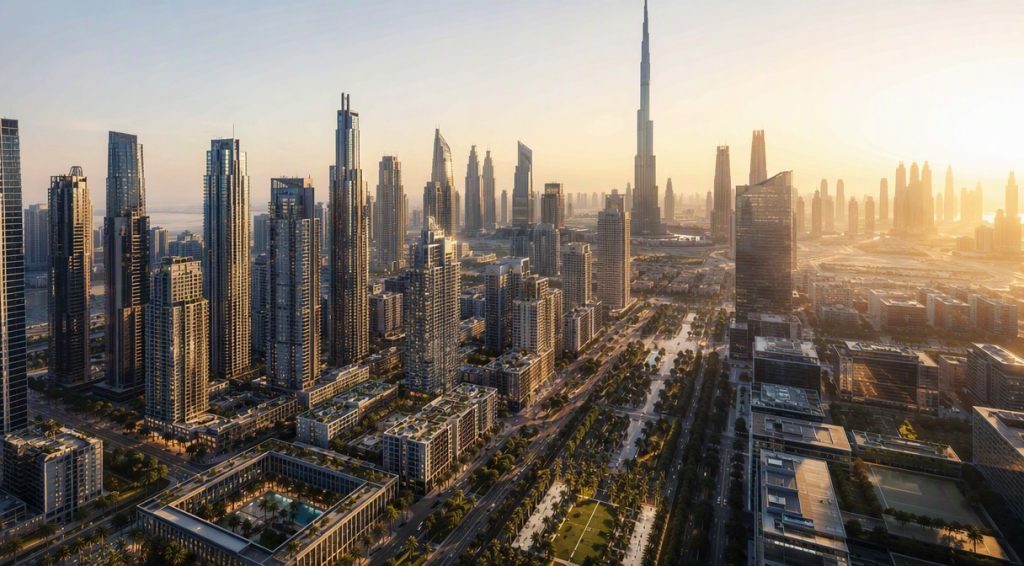
Emaar Properties has announced a Dh200 billion master-planned district "in the heart of Dubai", designed for nearly 150,000 residents across more than 4.5 million square metres of gross floor area. The developer of Burj Khalifa and Downtown Dubai describes it as one of the largest urban districts it has ever conceived — a "city within a city" organised on 20-minute-city principles, with five character zones, a central park, swimmable lagoons and a high-street boulevard.
What it does not yet have is a name, a precise location, prices, payment plans or a timeline. That distinction — between what is announced and what is purchasable — is where smart buyers should focus. This analysis separates the signal from the spectacle, and sets out what you should actually do about it, whether you buy in Dubai or Abu Dhabi.
Key takeaways
- The Dh200bn figure is Emaar’s estimated value of the entire multi-decade development — land, construction, infrastructure and margin. It is not a price list and cannot be divided into per-home prices.
- Nearly 150,000 residents implies roughly 50,000–60,000 homes over many phases — a significant but absorbable addition to Dubai’s pipeline, not a supply shock.
- Nothing is for sale yet. The rational buyer response is preparation (budget, finance readiness, area research), not urgency.
- Historically, the first phases of Emaar mega-communities have been their best-priced entries — but only for buyers already prepared when the unveiling comes.
- For Abu Dhabi investors, this is neutral-to-positive context, not competition: the capitals’ island communities sell scarcity and lifestyle, not scale.
| Element | Status |
|---|---|
| Total development value | ~Dh200bn (Emaar’s estimate for the whole district) |
| Planned population | Nearly 150,000 residents |
| Scale | 4.5m+ sqm gross floor area |
| Structure | Five zones: business hub, urban district, young-families cluster, family living, gated villa enclave (5–6BR villas and mansions) |
| Design principles | 20-minute city; central district park; high-street boulevard; swimmable lagoons; shaded promenades; cycling/EV routes |
| Views claimed | Towers facing Burj Khalifa, Burj Al Arab and Palm Jumeirah |
| Metro/smart mobility | Proposed, not confirmed |
| Name, exact location, prices, payment plans, timeline | Not disclosed — expected at a formal unveiling |
Founder Mohamed Alabbar called it the company’s "most extraordinary dream yet" — language that signals ambition and capital commitment, but carries no purchasable detail.
Headline development values aggregate everything: land, decades of construction, infrastructure, amenities and developer margin across tens of thousands of homes plus offices, retail and hospitality. Divided across, say, 50,000–60,000 homes over 15–20 years, Dh200bn describes a large but conventional master community build-out — comparable in spirit to what Dubai Hills Estate or Dubai Creek Harbour represent at earlier stages of their lives.
For perspective: Dubai recorded around AED 227bn of residential sales in H1 2026 alone. A district of this value, delivered over one to two decades, is meaningful commitment to central Dubai, but it is not a number that re-prices the market on announcement day.
The instinctive worry — "150,000 residents will flood the market" — deserves arithmetic rather than anxiety. Dubai’s population passed 4.2 million at end-2024 and has been growing by roughly 150,000–200,000 people a year in the current cycle. A district housing 150,000 people delivered over 15-plus years represents a fraction of one decade’s population growth, phased gradually.
The realistic risks are different:
If you are an investor: treat the announcement as a watch item, not an action item. Emaar’s pattern across Dubai Hills, Creek Harbour and The Oasis is consistent — the first release is typically the cheapest entry the district ever offers, and allocations favour prepared buyers. Preparation means: budget band fixed, mortgage pre-qualification or funds documented, and an advisor briefed to act at the unveiling. Buyers who start their paperwork on launch day buy in phase three.
If you are an end-user: nothing changes until location and product are known. If you need a home in the next two to three years, buy the home — existing communities with operating schools and finished infrastructure serve a family today in ways a masterplan render cannot.
If you already own Dubai property near the likely corridor: a major Emaar district is historically a rising-tide event for surrounding communities, not a threat. New infrastructure, retail and population lift adjacent areas.
Bramwell & Partners — Investor Proof
We help investors make money investing in Abu Dhabi properties — and we can prove it.
Download our Proof of Concept: three executed off-plan flips, real contracts, ≈62% blended ROI in 12 months with only 20% capital deployed.
Emaar has run this playbook before, and the record is instructive. Dubai Hills Estate’s earliest apartment phases launched at prices that looked full on announcement day and modest within five years, as the park, mall, golf course and hospital converted a masterplan into a functioning community. Dubai Creek Harbour followed the same arc: first-release buyers took the longest view and captured the steepest part of the community’s re-rating as infrastructure arrived.
The pattern has two edges. Early entrants in Emaar mega-communities have generally been rewarded for patience across a full build-out cycle — a decade, not a quarter. But buyers in later phases, released into strong markets at stepped-up prices, have often seen flatter outcomes. If this district follows the same shape, the value will concentrate in the earliest releases — which is precisely why preparation now, rather than urgency later, is the correct strategy. It is also why buying into the fifth phase of a mature district is a fundamentally different, lower-beta decision than buying phase one.
Expert view from Bramwell & Partners
"Mega-announcements test buyer discipline. The mistakes we see are symmetrical: some clients rush to ‘get in early’ on a project with no price list, others abandon sound purchases to wait for a render. The correct posture is boring — keep executing on verified opportunities today, and be documents-ready for the unveiling. The first phase of an Emaar district has rewarded prepared buyers repeatedly; it has never rewarded panicked ones."
In our advisory work, an announcement of this size reliably produces two client calls within the week. The first is from someone wanting to pause a sound, verified purchase to "wait for the Emaar launch" — our answer is that delaying a known asset for an unlocated, unpriced district is speculation, not strategy. The second is from a buyer wanting in at any price on day one — our answer is that even the best developer’s phase one only rewards buyers whose budget, financing and documents are already in order. A representative, anonymised case: a client preparing for an earlier Emaar mega-community had mortgage pre-approval and funds documented months before release and secured an opening-tranche unit; buyers who began their paperwork on launch week largely ended up in later phases at stepped-up prices. For the broader emirate decision, see our Abu Dhabi vs Dubai off-plan comparison.
Clients with capital allocated to Abu Dhabi sometimes ask whether a Dh200bn Dubai district changes the case for Yas, Saadiyat or Hudayriyat. Our view: no, and the reason is structural. The Abu Dhabi island thesis rests on scarcity — finite coastline, one master developer per island, disciplined supply of a few thousand units per community. Dubai’s model is scale and absorption — and this announcement is simply more of that model, executed by its best practitioner.
If anything, the announcement clarifies the choice between the two emirates: Dubai for liquidity and an ever-renewing pipeline; Abu Dhabi for constrained supply, end-user depth and lower entry costs per square foot. Both are investable; they are not the same trade. Diversified UAE investors can reasonably hold both — and we frequently structure portfolios that way across our off-plan and completed portfolios.
A master-planned district announced by Emaar in mid-2026, valued at around Dh200bn, designed for nearly 150,000 residents across 4.5m+ sqm in central Dubai, organised into five character zones. It has not yet been formally launched.
Emaar has said only "the heart of Dubai", with towers facing Burj Khalifa, Burj Al Arab and Palm Jumeirah. The exact site is expected at the formal unveiling.
No prices have been released. The Dh200bn is the estimated total development value, not a per-home guide. Pricing will arrive with the first phase.
Generally no — unless your horizon is long and flexible. The unveiling date, prices, location and first handover are all unknown; sound opportunities available today in Dubai and Abu Dhabi carry known prices, locations and timelines. The pragmatic approach is to buy well now and stay prepared for the unveiling.
A single announcement signals developer confidence and future supply rather than moving current prices. Effects on specific areas will depend on the revealed location and on phasing over many years.
Not materially. Abu Dhabi’s island communities compete on scarcity, lifestyle and end-user depth, not on scale. A mega-district in Dubai and a waterfront apartment on Hudayriyat are different assets serving different strategies.
Emaar has given no completion timeline or phasing. Districts housing 150,000 people are built over 15 to 20 years in multiple phases; the relevant date for any buyer will be the first phase’s handover, which has not been announced.
Register with Emaar directly and brief an independent advisor to monitor the unveiling. Launch allocations move quickly, and buyers with documentation and budgets prepared in advance consistently secure the earliest, best-priced releases.
Emaar has committed serious capital to central Dubai, and the eventual first phase will deserve serious attention. Today, however, there is nothing to buy — only a market signal to file and a preparation list to complete. Discipline now, readiness later.
How we verify this analysis
This piece is based on Emaar Properties’ official announcement (June 2026) and reporting by Gulf News and the Khaleej Times, with market context from DLD H1 2026 transaction records and Dubai’s official population bulletin (2024). Announced scale figures are the developer’s estimates; no prices, location detail or timeline exist yet, and nothing here should be treated as purchasable fact until the formal unveiling.
Disclosure: Bramwell & Partners may act for buyers in some projects mentioned; our analysis is independent of developers, and we do not accept payment for coverage.
Want to be first in line when the unveiling comes — without putting today’s plans on hold? Bramwell & Partners tracks every major UAE launch for clients across Abu Dhabi and Dubai. Browse our current off-plan projects and properties for sale and rent, or register your interest with our advisory team and we will contact you with verified detail the moment this district is formally released.
Sources: Emaar Properties announcement (June 2026); Gulf News and Khaleej Times reporting; Dubai Land Department H1 2026 transaction records; Dubai Data and Statistics Establishment population bulletin 2024. Forward-looking statements are indicative; no purchase decision should rest on unlaunched-project detail.
Institutional-Grade Investment Guidance
Talk directly to our advisory team
WhatsApp us at +971 56 494 7631 — we reply personally, usually within the hour.